Harmonia: Distribution layer for tokenized funds
Allfunds Blockchain & Solana
Allfunds Blockchain (AFBc) connects more than 3,300 asset managers and financial institutions, powering the full lifecycle of regulated investment funds. Solana is a fast, low-cost public blockchain that has become one of the leading networks for tokenizing real-world assets.
Context
Allfunds, together with Asseto, launched Harmonia to bridge institutional and decentralized fund distribution, given that tokenized funds have so far lived in separate worlds: distributed through institutional channels on one side, and through public DLTs on the other.
Financial Institutions operate within Allfunds regulated network, while growing base of on-chain native investors and liquidity sits on public blockchains like Solana, with no compliant channel connecting both.
Two distinct issuance and distribution models add an extra layer of complexity: a fund can originate on Allfunds blockchain and be extended to Solana, or originate natively on Solana and be distributed through Allfunds. Each of these models requires its own consolidated off-chain record reconciling activity across both networks.
The challenge was to give tokenized funds a single point of access across both traditional and on-chain rails, without asking asset managers or Transfer Agents to change how they are operating.


Asseto enabled the tokenization and cross-network distribution of institutional funds on Solana
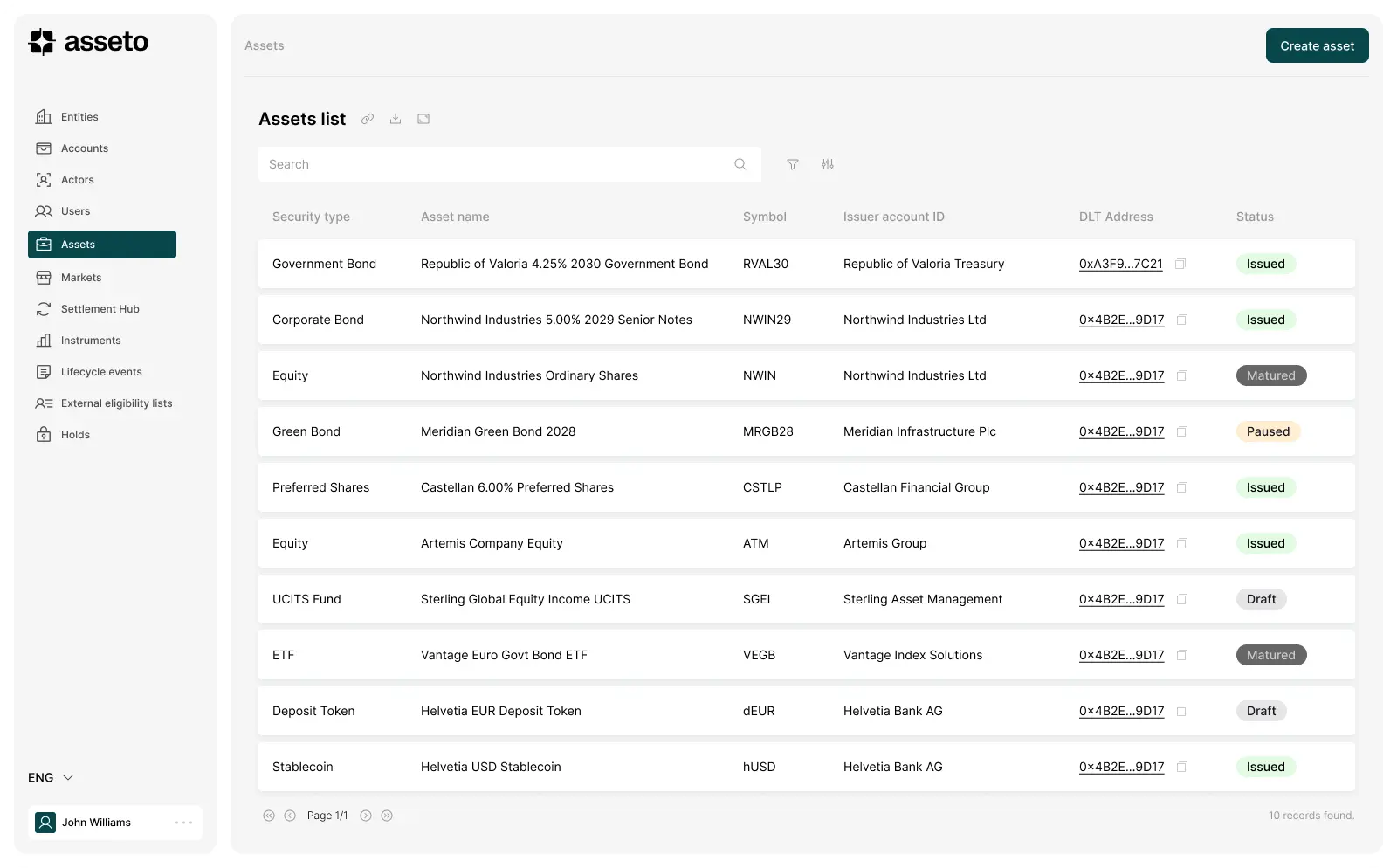
Asseto, deployed con Solana as ioBuilder’s institutional tokenization platform, provides the infrastructure to issue and manage SPL tokens representing real-world financial assets, including mint/burn mechanics, investor whitelisting, compliance controls and event notification systems. Blockchain-agnostic and API-first by design, it integrates with existing financial systems rather than replacing them, connecting Allfunds Blockchain institutional distribution network with Solana’s on-chain liquidity.
Multi-network fund issuance
The integration supports two different models. First, a Transfer Agent operating within Allfunds Blockchain issues a fund on the Allfunds network and simultaneously extends it to Solana via Asseto, with both Allfunds and Solana distributors able to subscribe and redeem. In the second, a fund manager or Transfer Agent issues a fund natively on Solana through Asseto, which Allfunds registers off-chain for aggregation and makes available through its Dealing Marjet without issuing it on its own network.
Technical architecture
The solution runs across three integrated components, the Allfunds Blockchain that covers fund registry, Dealing Market, order management and off-chain aggregation. Asseto, handling SPL token issuance, mint/burn execution, event notification and off-ramping. And Solana, providing on-chain settlement, token lifecycle and transaction finality.
Unified off-chain registry
Allfunds maintains a consolidated fund registry tracking all subscription and redemption activity across both networks, including transactions hashes, timestamps, amounts and distributor identifiers, regardless of which network an order is originated from.
Business and regulatory foundation
The technical integration is paired with defined product perimeter, operating model, legal characterisation and commercial framework, with KYC/AML and regulatory compliance validated for each participating institution ahead of go-live.
Issuance
A fund is created either on Allfunds and extended to Solana, minting an SPL token bound to the fund’s class record, or issued natively on Solana through Asseto and registered off-chain in Allfunds.
Subscription and redemption
Orders from Allfunds blockchain distributors and Solana distributors are both executed by Asseto, minting tokens on subscription and burning them on redemption, with every confirmed event recorded in Allfunds Blockchain off-chain registry.
Off-ramping
Asseto provides direct off-ramping from stablecoins to fiat bank accounts, closing the loop between on-chain execution and traditional settlement.
A production-ready platform
Not a solution you have to build.